0

Lo, Judah's Lion Wins the Strife

church window slide show 7Our hymn of the week each year for Quasimodogeniti is John Bajus' translation of Lo, Judah's Lion Wins the Strife.

Besides having a wonderful melody, it relates Biblical stories which children have learned to the work of Christ with stanzas like "'Tis He whom David did portray when he did strong Goliath slay . . . " and "Like Samson, Christ great strength employed and conquered h ell, its gates destroyed." (TLH 211) The hymn is not found in LSB.

Continue reading
0

Google Earth, Chromebooks, and Chrome Browser

Google Earth used to be a program one had to download, install, and update - but no longer.

For those who have Chromebooks or the Chrome browser, Google Earth is available online: http://earth.google.com (You must use the Chrome browser to access it.)

This is exciting news for teachers who can now make use of KML and KMZ files to highlight geographical locations found in literature, history, and science. So, for example, one can follow the apostle Paul on his missionary journeys.

I found this "Google Lit Trip" for Mary Shelley's Frankenstein which we just completed reading: There are Google Lit Trip KML files for Make Way for Ducklings, Paddle to the Sea, Around the World in 80 Dyas,  the Odyssey, the Aeneid, the Life of Luther, and more.

You can search for KMZ and KML files by including "file:kmz" or "file:kml" in your Google search bar -- and by learning more about Google Lit Trips. (I plan on creating some for the missionary journeys of St. Paul, but if someone else beats me to it, let me know!) See How to Create a Google Lit Trip.


Continue reading
0

Orwell or Huxley?

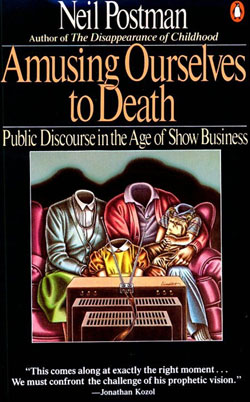
Postman AmusingHave you ever had the sensation of reading something profound? Have you ever been impressed that san author could write something so timely -- but had written it decades ago?

One might not be surprised to have that experience while reading or listening to the Holy Scriptures regarding faith, hope, and love in Christ -- but there are other spheres in which something similar may happen. That was my reaction when I read this Foreward to Neil Postman's Amusing Ourselves to Death (pp. vii-viii):


 We were keeping our eye on 1984. When the year came and the prophecy didn’t, thoughtful Americans sang softly in praise of themselves. The roots of liberal democracy had held. Wherever else the terror had happened, we, at least, had not been visited by Orwellian nightmares. But we had forgotten that alongside Orwell’s dark vision, there was another-slightly older, slightly less well known, equally chilling: Aldous Huxley’s Brave New World.

Contrary to common belief even among the educated, Huxley and Orwell did not prophesy the same thing. Orwell warns that we will be overcome by an externally imposed oppression. But in Huxley’s vision, no Big Brother is required to deprive people of their autonomy, maturity, and history. As he saw it, people will come to love their oppression, to adore the technologies that undo their capacities to think.

What Orwell feared were those who would ban books. What Huxley feared was that there would be no reason to ban a book, for there would be no one who wanted to read one. Orwell feared those who would deprive us of information. Huxley feared those who would give us so much that we would be reduced to passivity and egoism. Orwell feared that the truth would be concealed from us. Huxley feared the truth would be drowned in a sea of irrelevance. Orwell feared we would become a captive culture. Huxley feared we would become a trivial culture, preoccupied with some equivalent of the feelies, the orgy porgy, and the centrifugal bumblepuppy.

As Huxley remarked in Brave New World Revisited, the civil libertarians and rationalists who are ever on the alert to oppose tyranny “failed to take into account man’s almost infinite appetite for distractions.” In 1984, Huxley added, people are controlled by inflicting pain. In Brave New World, they are controlled by inflicting pleasure. In short, Orwell feared that what we hate will ruin us. Huxley feared that what we love will ruin us.

This book is about the possibility that Huxley, not Orwell, was right.

Continue reading
0

Create Vocabulary Lists with EasyDefine and VocabGrabber

Do you have a list of words for which you'd like definitions, but would rather not have to look up each word individually? Then, the free online version of EasyDefine could be just the thing.

Have you ever taught a literature unit where the author used many words which might be unfamiliar to your students? VocabGrabber might be a big help, especially if the text is in public domain, found on such sites as Project Gutenberg.

A teacher can select and copy an entire chapter of text from the book (up to 100 pages) and paste it in VocabGrabber (https://www.visualthesaurus.com/vocabgrabber/). VocabGrabber will create a list of words likely to be challenging to students, and let the teacher pick from those words as to which would be saved in a list. The option exists to include the word in the sentence where it is used in the book.

Those particular features may require teachers to subscribe for about $20 a year -- and the interface isn't especially easy to cut and paste into a Word document. However, there is another free version which produces similar results found at Vocabulary.com (https://www.vocabulary.com/lists/vocabgrabber).

Note: Teachers might also like Vocabulary.com to create spelling and vocab lists for their classes each week -- such as lists which incorporate words actually found in contemporary news items and journal articles. The subscription site also provides online testing of the various word lists. And don't forget such resources as SpellingCity.com and Quizlet.com to help your students practice their words.


Continue reading
0

OneLook for Many Words

I'm told that the Oxford English Dictionary (OED) contains around 600,000 entries. While nothing can surpass the OED as an authoritative resource, the website OneLook.com references 18,955,870 words indexed from 1061 dictionaries.

This can be especially helpful for students working on poems and other composition exercises.

Additionally, there is even a "Reverse Dictionary" feature which can help you find the mot juste simply by describing a concept and then it returns a list of related words.

Examples of OneLook.com searches

bluebird                    Find definitions of bluebird
blue*                        Find words and phrases that start with blue
*bird                         Find words and phrases that end with bird
bl????rd                  Find words that start with bl, end with rd, with 4 letters in between
bl*:snow                  Find words that start with bl and have a meaning related to snow
*:snow or :snow      Find words related to snow
*:winter sport          Find words related to the concept winter sport
**winter**                Find phrases that contain the word winter
expand:nasa           Find phrases that spell out n.a.s.a.


Continue reading
0

Resources for Teaching Literary Devices

What's the difference between synecdoche and metonymy? Where might one find examples to teach the various literary devices such as personification, hyperbole, and alliteration? Give these a try:

    YourDictionary

   LiteraryDevices.net

    K12Reader.com

Continue reading
0

Unearthed in Rome's New Subway

Do civil engineers make good archaeologists? Those currently working on Rome's latest infrastructure, the subway, have been digging up some amazing finds. Check into A Centurion's Digs and Extinct Elephants and Persian Peach Pits.

Continue reading
0

Zingo!

VocabularyI occasionally like to invent classroom games which will enhance or spice up the learning quotient among my students. The lastest one is Zingo! (I originally called it "Ding!" but the students decided "Zingo!" would be better.)

The game goes like this: I to slip one of our vocabulary words past them by using it nonchalantly in casual classroom conversation. If they take note of that word, they are to say "Zingo!" and they get a point on a chart I made -- two points if they can define the word.

A second aspect of this game occurs when a student can use the word in classroom discussions -- for which they will get two points.

I've also used other standard word games to help students learn that words can be fascinating. A number of these games can be found online such as classic word jumbles and Boggle. You might have other favorites such as Scrabble or crossword puzzles.  Others are more board-like games such as Balderdash.

Also, check out Wordnik.


Continue reading
0

1587 Map of the World

mappityAn extremely rare and massive 16th-century map has been been fully assembled and digitized for the first time ever.  The three-by-three metre map, the largest map of the world made during the Renaissance, brims with mystical beasts and elaborate drawings. It was created in 1587 by little-known Italian geographer Urbano Monte. Check out the details HERE.

Continue reading
0

Curriculum Mapping

course mason

"Curriculum mapping is a process for collecting and recording curriculum-related data that identifies core skills and content taught, processes employed, and assessments used for each subject area and grade level."

Would classical Lutheran education find any value in identifying core content and skills (emphasis on the content)? Or is education much more organic than an objective classification of academic instruction?

Course mapping has been very popular in many educational circles which wish to standardize or objectivize education -- which can be a rather sterile approach to learning. However, since the software or cloud-based services are rather expensive, classical Lutheran educators haven't had much opportunity to review it or try it (or devise criteria for what makes education particularly "classical" and "Lutheran").

Course Mason, however, is a free, cloud-based course mapping utility which will allow classical Lutheran educators to check it out . . . and even to peruse and review the Common Core standards contained therein.

Continue reading
0

Mind Mapping

WiseMappingOn one hand, mind mapping might just be another distraction created by progressive educators to make students look like they're doing something when in fact they are wasting time when tried-and-true classical methods would do just as well if not better. On the other hand, mind mapping might be a way for disorganized students to learn a step-by-step method in a visual way -- who can then move on to outlining and the proper format of paragraphs.

There are ways to do mind mapping with pencil and paper which may serve either to outline an essay or as a variant form of note-taking. A simple Google search can turn up many resources and YouTube videos such as Ten Mind Mapping Strategies or Using mind mapping as a memorable fact-retention tool.

There are mind mapping programs which can be installed on computers or cloud-based services often cost money which frugal classical Lutheran educators have learned to do without. With WiseMapping.com, however, you (and your children or students) can determine whether cloud-based mind-mapping is a useful tool or just another distraction.

Have  you used mind-mapping successfully and can offer some sample classical lesson plans? Do you have outlining and paragraph-building exercises you'd like to share?

Continue reading
0

TED . . . and Classical Education

indexTED lectures run the gamut from liberal to conservative. One can even find some lectures on classical education. You may enjoy watching What If Everyone Had a Classical Education? There are also numerous YouTube videos which may provide some grist for your mill like Classical Education vs. Common Core.


Continue reading
0

Let's Get Analogous

teacherThe Wordly Wise and Vocabulary from Classical Roots workbook series are popular in many classical Lutheran schools. One feature of the chapters and tests is a section on analogies. One must match poor : money; tired : energy . . . or "Poor is to money as tired is to energy."

These analogies often proved quite challenging to my students. I started looking for ways to teach analogies which provided copious examples. One free resource I found was found here: Teaching Analogies.

I downloaded the free instructional material, worksheets and answer keys . . . and recently I have been converting them to Moodle quizzes so that students can take the quizzes online on ILLA our classical Lutheran LMS. This not only gives students the ability to have plenty of practice, but it also gives them instant feedback. I often use these once a day three or four times each week.

Continue reading
0

Nota Bene

handwritingHearing a teacher say, "Just take notes," may leave students somewhat bewildered as to what to do. It might be helpful to teach students about note-taking -- about organizing one's thoughts on paper or recording ideas in an orderly manner. The Cornell Note-Taking System is one method which has proved to be quite sucessful for many students. (This website also has several other study-skill topics.) Note-taking need not only be limited to live lectures. It could also be used for watching educational videos and online presentations.

Continue reading
0

Printable Paper

PrintablePaperPenmanship paper. Music staves of every variety. Hexagon paper. 3D paper. Perspective paper. Polar co-ordinate paper. Just about every kind grid or column  paper you can imagine is available free for download at Printable Paper . . . or you can save your time and purchase the full library of 800+ styles and templates for $39. These papers privide numerous options for everything from math to science to art.

Continue reading
0

Big Words for Little Children

Sanctimonious. Eau de toilette. Commode. Frappe. Hideous. Banshee.

These are not the kind of words we would expect many children to know — or spell. These very words, however, were heard in the first fifteen minutes of The Spooktacular New Adventures of CasperCasper [the Friendly Ghost], a cartoon I sat down to watch with my sons one morning when they were young (late 1990's - a rather different version than what I grew up with in comic books and tv in the 1960's).

The network rated this cartoon with a “Y” which meant that it was suitable for children under 7.

I watched this cartoon from a rather different perspective than my sons. Not only did I wonder about the propriety of them watching ghosts being frappeed in a commode, but I also wondered what was going on in their minds since they hadn’t the slightest idea what such words meant. Did they come to associate these words with what they saw — or did they pass through one ear and out the other, making no concrete connection with the glassy-eyed, mezmerized gaze into a large-screen LCD?

Schools in general have been dumbing down the curriculum for the children. The latest thinking in the elementary education field is that children should be given only five vocabulary words since studies have shown that most children can’t remember more than that. And there are scores of Christian education pundits who would dumb down the liturgy and hymnody of our church, espousing children’s sermons and musical ditties with the belief that such childishness is appropriate for children. It is not. And while I could agree that the words in the aforementioned episode of Casper seem a bit much for small children, I doubt that the network got angry letters from parents complaining that the script writers needed to get realistic.

Our children may run into some big words in our hymns and liturgy which they don’t understand. We need not feel compelled to present an etymological lecture about every word encountered. A passing attempt will suffice while our children are growing into their vocabulary. In time, they will be taught what such “difficult” words mean instead of being programmed to avoid the big words, letting them fall into the oblivion of disuse.
Words can be received and stored up before the meaning of them becomes known.

The subsequent knowing, especially regarding the words of faith, will not be achieved solely by experience, intuition, or rationalization. If they were, there would be little left for the Holy Spirit to do. We might well prefer that our children not learn words by associating them with the antics of animated characters, but by having them associated with the living Word of God. Thus they will come to know and love “big” words — words judged to be big not because of the number of syllables, but because of the wealth of meaning and life conveyed therein. Justification. Expiation. Incarnate. Propitiation. Christocentric. Forensic. Sanctification.

Continue reading
0

Teaching Vocabulary

I've used various resources to teach vocabulary over the years such as Vocabulary from Classical Roots (noting the Greek and Latin morphologies of the English language) and Wordly Wise 3000. I've made up my own weekly assignments, sometimes letting each student pick a word from the free 5000 word SAT vocabulary list.

Lately, I've been making use of Vocabulary.com which provides pre-made lists using words from current news articles in their "This Week In Vocabulary" collections (though they also have any number of other collections ranging from World Series baseball terms to helpful poetry terms.

The website offers (for a small fee) the ability to educators of providing practice, quizzes and spelling bees for the students. While the grade-recording is a bit cumbersome, it can still help free up some time for other things a teacher must prepare and supervise.

However, as I learn the website, I found an even more impressive tool within. I've often wanted to teach vocabulary based on the literature I am having the class to read.I believe that reading literature is one of the best ways to grow a vocabulary - if one bothers to keep a dictionary close at hand while reading.

I have, in the past, slogged through chapters, underlining every word which I thought might be unintelligible to students and typed my own vocabulary lists and exercises. Very time-consuming.

But then I find that one can cut-and-paste an entire chapter into the "Create a New List" Vocabulary.com feature . . . and the site automatically creates the list for me! Marvelous! This will be especially helpful as we take up the novel Frankenstein once more. Give it a try with anything from The Scarlet Letter to Paul's first letter to the Corinthians.

Continue reading
0

Is Classical Literature "Readable"?

FahrenheitI once had a parent ask me why I had our 7th and 8th grade students reading literature which the local public high school students were reading in their sophomore year (with the implication that I was expecting too much from the students in my class). I responded by asking the parent why the high schools were using middle school texts to teach literature at the high school level.


I was not intending to be glib. The Huffington Post, for example, treated the same question in the article "American High School Students Are Reading Books at 5th-Grade-Appropriate Levels."

Can parents and teachers rely on anything more than "trial-and-error" when selecting literature which matches the reading ability of their children and students?

Some may turn to the reading lists of various classical schools and recommended curricula, but they might also ask how such lists were compiled.

Those who follow such lists may find that the literature ranges from too simplistic to too challenging only after having attempted them. If a book doesn't work out, one has to deal with wasted money and effort pursuing literature which did not satisfy. It would be nice if one could determine the readability of an appropriate text for a particular age level prior to buying the text and embarking on preparations to digest it.

Enter the world of readability metrics. In a world which approaches reading from the perspective of science rather than art -- and which imagines that statistics and data can improve everything -- it is no surprise that the act of reading has come under the digital scrutiny of measurable quantification as can be evidenced in the results of standardized testing.

If you wish to dabble in this area, you might check out this presentation given at an American Library Association (ALA) conference which explains various "online calculators" and databases for finding books. Detailed explanations of readability formulas may also be found online such as this one which describes the Flesch-Kincaid scale.

You might even consider report of the Council of Chief State School Officers and the National Governor's Association regarding Common Core's "New Research on Text Complexity."

Or if you would simply like to experiment with matching book levels to reading ability, you might try the Lexile Bookfinder or the Accelerated Reader Bookfinder. You can even find Lexile indicators on Amazon (see the left-hand column). See how Barnes and Noble has adopted and incorporated the Lexile framework.

If a child participates in such standardized tests as the Iowa Test of Basic Skills (ITBS) or the NWEA's Measure of Academic Progress (MAP), the teacher test coordinator can probably get the Lexile, AR, or Flesch-Kincaid reading level numbers for that child so that parents or teachers can use them.

In my own experience, the readability scales are not foolproof or entirely reliable. For example, my middle school students claim to have more difficulty reading Captains Courageous which has a Lexile score of 850L than The Trumpeter of Krakow which is rated at 1200L. (The reading levels in my current class range from 465L to 1355L which makes things interesting.)

I still make reference to such scales in an attempt to match books to readers, even though, after teaching literature over the past twenty years, I have a pretty good feel for the difficulty levels of various books for my students. The only problem is: I have not been able to quantify such feelings with statistical metrics.

Continue reading
0

Class Management Templates

Classroom management and organization are vital so that classical content does not get lost in a tangle of day-to-day mismanaged disorganitzation.

Excel templates are readily available to teachers and headmasters, saving money on gradebooks, copier paper, toner, and the like. Such things as planbooks can also help a headmaster make certain that classrooms are staying on task efficiently.

Many free templates are available across the web, but as an example, check out Vertex42's Excel templates for gradebooks, planners and calendars.

For a small annual fee (less than the price of a wire-bound hardcopy gradebook), administrators, teachers, parents, and students can have access to weekly lesson plans and assignments through PlanBookEDU's full-featured online planning book.

Chromebook and G-Suite users should also be able to find numerous solutions in various apps.

Continue reading
0

Virtual Dissections

Small classical Lutheran schools may not have the resources to purchase specimens and dissecting equipment, but there are free websites which can provide the next best thing: virtual dissections (although there are also those which require a fee for use). Check out the resources listed on the ScienceBank website.


Continue reading

EasyBlog - Posts List

Go to top