0

Political Campaigns as Pseudo Events

Are the current political candidates heroes . . . or celebrities?

In 1961, Daniel J. Boorstin published The Image: A Guide to Pseudo-Events in America, contrasting heroes and celebrities in chapter 2:

"The hero was distinguished by his achievement; the celebrity by his image. The hero created himself; the celebrity is created by the media. The hero was a big man; the celebrity is a big name. Formerly, a public man needed a private secretary for a barrier between himself and the public. Nowadays, he has a press secretary, to keep him properly in the public eye. . . . The man of truly heroic statue was once supposed to be marked by a scorn for publicity. He quietly relied on the tower of his character or his achievement.

". . . The hero was born of time: his gestation requuired at least a generation. As the saying went, he had 'stood the test of time.' A maker of tradition,he was himself made by tradition. He grew over the generations as people found new virtues in him and attributed to him new exploits. Receding into the misty past, he became more, not less, heroic. It was not necessary that his face or figure have a sharp, well-delineated outline, not that his life be footnoted. Of course there could not have been any photographs of him, and often there was not even a likelness. Men of the last century were more heroic than those of today; men of antiquity were still more heroic.

". . . The celebrity, on the contrary, is always a contemporary. The hero is made by folklore, sacred texts, and history books, but the celebrity is the creature of gossip, of public opinion, of magazines, newspaers, and the ephemeral images of movie and television screen. The passage of time which creates and establishes the hero, destroys the celebrity. One is made, the other unmade, by repetition. The celebrity is born in the daily papers and never loses the mark of his fleeting origin. The very agency which first makes the celebrity in the long run inevitaably destroys him. He will be destroyed, as he was made, by publicity. The newspapers make him, and they unmake him -- not by murder but by suffocation or starvation. No one is more forgotten than the last generation's celebrity." (pp. 61-63)

Thus Boorstin opined: "Celebrity worship and hero-worship should not be confused. Yet we confuse them every day, and by doing so we come dangerously close to depriving ourselves of all real mdels. We lose sight of the men and women who do not simply seem great because they are famous but who are famous because they are great. We come close and closer to degrading all fame into notoreity." (p. 48)

Someone (not I) posted a PDF scanned copy of that chapter here: From Hero to Celebrity.

In the same vein, readers may also want to peruse Neil Postman's Amusing Ourselves to Death and How to Watch the TV News.


Continue reading
0

Education: From Luther to Lutheran

Luther 02If we read Luther's treatises on education, introductions to the catechisms, and the visitation articles which describe a Lutheran school curriculum, would we find anything remotely similar to Lutheran education today? Is there any reason why it should?

In the introduction to his 1963 dissertation for the EdD program at Columbia University entitled The Growth and Decline of Lutheran Parochial Schools in the United States, 1638-1962, John Silber Damm notes the following:

"This project is concerned with the growth and decline of the parochial school among the Lutherans of the older bodies and the Missouri Synod. What happened? Why is it that, although both groups developed their school systems from the same basic commitment of the church to provide a Christian education for their children, the schools of the older Lutheran bodies declined during those very decades of the nineteenth century when the Missouri Synod was active in establishing schools? Why were the older Lutheran bodies unsuccessful in their attempts to revive interest in parochial education? Why was the Missouri Synod able to withstand attempts to close its schools and continue its system of parochial education to this day? The present study seeks to answer these questions.

It is the thesis of this study that, although the Lutheran parochial school was troubled with many problems that threatened its existence - lack of teachers and training institutions, meager financial support, immigration and language difficulties, and the rise of the common school, the growth and decline of the Lutheran parochial school is essentially dependent upon the confessional stand and organizational structure of the respective sponsoring bodies.

The historic confessional stand of the Lutheran Church insists that the Christian Church is to be found wherever the Word of God is correctly and purely taught and the Sacraments administered according to Christ’s institution. The form of polity which the Church adopts is secondary and does not alter the nature of the Church. Hence, the more determined a synod is to maintain purity of teaching, the stronger the organizational arrangement will be to insure this.

This study will attempt to demonstrate that the older Lutheran synods, due to their decentralized organizational structure and minimal doctrinal requirements, were not able to maintain or develop the school system an earlier generation had planted, and that the Missouri Synod, with its conservative confessional basis and stronger organizational structure was able, not only to establish a parochial school system, but to maintain it throughout the synod’s history in this country."

Continue reading
0

Catechesis vis-a-vis Lutheran Education

Jules Alexis Muenier La Leçon de catéchismeReligion? Bible Study? Catechesis? Didache? Some struggle a bit with what to call the subject of teaching the faith whether it is referenced in a school's curriculum or on a congregation's calendar. The disambiguation of these might be taken up elsewhere, but I'd like to consider for a moment the juxtaposition of "catechesis," referencing in particular Luther's Small Catechism and "Lutheran education" in general.

There have been conferences and papers devoted specifically to "catechesis" almost as if it were something which existed in its own niche. I have not often found a treatment of catechesis depicted in the big picture of Lutheran education. Are the methods of catechezing markedly different from educational methods in general? And how does a commercially-produced religion curriculum from a Lutheran publishing house relate or compare to catechesis as such? Are they two different disciplines?

Can various approaches to catechesis range from nominalist to the progressive? On one hand, there can be an emphazing of teaching faith as if it consisted primarily of memorizing definitions of every concrete and abstract term in the Bible and memorizing the facts of Biblical accounts. On the other, it could be a pietistic, Romanticized moralizing of life.

Can one find examples of teaching-the-faith in the context of the liberal arts, an age-appropriate grammatical, dialectical and rhetorical Trivium of the faith? What would catechesis look like if one construed catechesis into the grammar, dialectic, and rhetoric stages?

I'd like to see a more deliberate approach towards how children can make the transition from concrete Biblical narratives to abstract Scriptural epistles. To date, I have not seen any curriculum achieve that. (And in the limited time I have between writing lesson plans, grading papers, fixing computers and ordering supplies, there is little leisure fo attempt one myself.)

Additionally, consider a list of distinctively Lutheran doctrines dealing with aspects of faith such as the proper distinction between Law and Gospel, simul iustus et peccator, the theology of glory as opposed to the theology of the cross, the two kingdoms, the priesthood of all believers (and there are many more). And consider the dangers which our children are facing in high school and college designed to fleece them of faith in the Good Shepherd: constructivism, materialism, nihilism, feminism, not to mention all the other powers and principalities which are set against them.

Can encouragements and cautions, promises and threats, be sufficiently covered in once-a-week Saturday catechism classes? And if not (and if a congregation or home school has the opportunity for extended teaching of the faith) where does one find a curriculum which deliberately nurtures, disciplines, and trains children to grow in the grace and knowledge of the Lord Jesus Christ, propelling them into a lifelong education of faith, hope, and love in Christ?

While I am familiar with the Concordia Curriculum Guide which purports to be "a practical, easy-to-use, dynamic new resource that equips Christian educators to incorporate the faith into every lesson throughout the school day" integrating "the Christian faith into every aspect of your curriculum," I don't get the impression that this fits the bill. Is it too contrived and stilted? Is it possible that there could be something better wherein one could conceive of a K-8 curriculum which treats catechesis in the way of the liberal arts, giving attention in content and method to the grammar, dialectic and rhetoric stages of the Trivium?

Continue reading
0

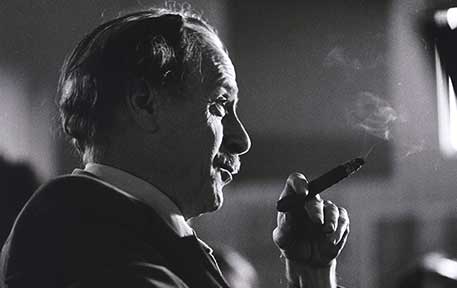
Marshall McLuhan and the Classical Trivium

Perhaps like many people, I knew little more of Marshall McLuhan than a few of his pithy witticisms like "The medium is the message," and "We shape our tools and thereafter our tools shape us." (Or even "Diaper spelled backwards spells repaid. Think about it.") These were sufficient for me to have a skin-deep appreciation for one who liked to play with words.

But to my surprise, when milling about in some backwater website, I came across a used book entitled The Classical Trivium by Marshall McLuhan. I couldn't not buy it. It turned out that this book, edited by W. Terrence Gordon, is the publication of his doctoral thesis from Cambridge University where he studied between 1934 and 1936.

While I have only begun to turn the pages, I wanted to post this in hopes that someone else here might know something about it -- or to tip off others for whom this book might also offer some helpful threads to pull. The Table of Contents runs like this:

     I: The Trivium Until St. Augustine

    II: The Trivium from St. Augustine to Abelard

   III: The Trivium from Abelard to Erasmus

   IV: Thomas Nashe

and for each section, there are A, B, and C sub-sections entitled Grammar, Dialectics, and Rhetoric.

There is little which could be deemed pithy in this dissertaion -- perhaps the Cambridge dons would not have suffered such. Witticisms would have appeared out of place in this substantive treatment, but one cannot help but wonder how this laid the foundation for McLuhan's later observations of Western media. 

While not writing for the casual reader, McLuhan introduces us to other works such as Aubrey Gwynn's Roman Education from Cicero to Quintilian which might be more readily accessible: "when the Church became the inheritor of the Graeco-Roman civilization, she used the artes liberales as a convenient framework for the new Christian education taught in her schools" (p. 246).

Continue reading
0

So Little for the Mind

NeatbyIn 1953, a Canadian educator by the name of Hilda Neatby, hit a nerve with her book, So Little for the Mind. She drew the title from a Cardinal Newman quote, "Any self-education in any shape, in the most restricted sense, is preferable to a system of teaching which, professing so much, really does so little for the mind."

Neatby caused a stir because of her disrespectful use of the expression "expert in education," considering it to be an insult to a noble calling. "It degrades the most difficult art of nourishing and disciplining and inspiring the mind to the level of a special technique. It de-humanizes education. I could pay no higher compliment to an educational leader than to say that, although he may have expert knowledge in certain fields, that is the leat of his qualifications for the extremely important work that is given him to do."

Even though some of the details of her work address issues in the Canadian system of education, she has much that is worthwhile for the consideration of education as a whole. I include this extended excerpt from her Introduction, in which it is declared that Progressive education is anti-intellectual, anti-cultural, and amoral (p. 15 f):

"Democratic equalitarianism encouraged the idea of a uniform low standard easily obtainable by almost all. Special attention was given to all physical, emotional, and mental abnormalities, but the old-fashioned things called the mind, the imagination, and the conscience of the average and of the better-than-average child, not not exactly forgotten, slipped into the background. As a result, the much-maligned tranditionalist is now retorting with some pretty rigorous criticisms of progressive education as he sees it.

"It is frankly anti-intellectual. There is no attempt to exercise, train, and discipline th mind. This is old-fashioned language, now forbidden by the experts, but its meaning is still clear to the literate person. The traditionalist firmly and even brutally conveyed a body of facts which must be learned precisely, and which provided, as it were, the material of thought. Or he might demonstrate the process of thought through the admittedly painful process of causing the pupil to memorize a mathematical proposition and its proof. True, the matter often began and ended with memorizing, and never reached the stage of thinking. The progressivist noted this, but instead of taking over and doing the thing properly, he threw up the sponge. Because, he argued, inteelectual training is difficult and painful and many fall by the wayside, throw it out alltogether. Failures spoil the record. The denial by the schools of the duty of intellectual training is neatly reflected by the current fashion of lightly dismissing in argument an unanswerable fashion of lightly dismmissing in argument an unanswerable proposition as "a question of semantics."

"Progressivism is anti-cultural. This is quite in keeping with the revolutionary, pseudo-scientific materialist fashions of the day. In this scientific age, we find that everything, not just educational methods, but everything, is better than it used to be. It is the pride of the machine age that we can now understand, manipulate, and control men as we do machines. Why should we look at the evidence of human joys, sorrows, failures, and achievenments of the past? It would almost be an admission of defeat. We manage everything better now. . . .

"Progressive education is, or has been, amoral. There is something of a reaction today, but for a generation it has been unfashionable, to say the least, to speak openly of right and wrong actions. Teachers take cover instead under "desireable" and "undesirable" "attitudes" or "responses." But these are not enough. The pupil soon learns that in a democratice society he has as much right as anyone else. Even the elementary discipline of establishing rules which the child was required to keep was questioned. True, rules certainly existed in practice; but pragmatic theory frowned on all external control and therefore rules were enforced uneasily and with a bad conscience. The general tendency of the progressive approach has been to weaken respect for law and authority as such, and to dull discrimination between right and wrong, by the teaching, implied if not expressed, that "desireable" actions on the part of the child (actions pelasing to others) will bring "desireable" responses (actions pleasing to him)."

Continue reading
0

Theology by Analogy

Many pastors and teachers resort to analogies,  allegories, and abstractions -- figures of speech -- when explaining the Bible and theology to children. Some of them are quite creatively-presented in puppet shows, "object lessons," Children’s sermons, skits, and multimedia. Such practices, however, deserve some scrutiny among classical Lutheran educators.

One red flag regarding the use of use of analogies to teach children comes from some of the heroes of progressive education themselves, e.g. Jean Piaget and Lawrence Kohlberg. While classical educators may look askance at the prescriptions of such child developmentalists, they need  not entirely eschew the descriptions of their observations. So, for example, the demonstration that young children are not capable of comprehending the kind of analogies likely to be present in an object lesson, not to mention distinguishing between fact and fiction, reality and imagination, good and bad, silly and serious.

It is beyond the scope of this brief essay to relate the basic principles of concrete, formal, operational stages and moral development -- which can easily be found online. The point of this informal composition is to highlight some considerations about teaching theology by analogy -- and if someone wishes to address it more fully, formally and carefully than I have do here -- well and good.

In the realm of theology, if one asks, "Why did Jesus teach with parables?" many people are likely to repond with something to the effect that Jesus was using parables as illustrations to explain a thological point.

But if one rephrases the question thus: "What did Jesus Himself say was the reason that He told parables?" one might get a blank expression from the same respondents as they hear Luke 8:10, "To you it has been given to know the mysteries of the kingdom of God, but to the rest it is given in parables, that 'SEEING THEY MAY NOT SEE, AND HEARING THEY MAY NOT UNDERSTAND" [Isaiah 6:9-10; Matthew 13:13-14; Mark 4:11-12].

Additionally one might point out that if parables were intended to make things easier to understand, then why did Jesus' own disciples fail so frequently to understand what Jesus meant by His parables, asking Him to explain them? Indeed, why do they say, "See, now You are speaking plainly, and using no figure of speech!" (John 16:29; cf. v. 25)

Furthermore, when Jesus makes statements like "I am the Door" or "I am the Bread of Life," we must ask, "Is our Lord merely using a figure of speech to convey an esoteric truth?" If Jesus is only a metaphorical door or if He is only a symbolic bread of life, then where is the REAL door? Where is the REAL bread of life? I cannot live by metaphor. My faith cannot cling to a figure of speech. I need true door and an actual bread of life. I don't need an analogous Christ -- I need a real Savior.

The following quote (a secular acknowledgement of the limitations of metaphor attributed to the French philosopher Paul Valery), makes a good point: “The folly of mistaking a metaphor for a proof, a torrent of verbiage for a spring of capital truths, and oneself as an oracle, is inborn in us.”

And this essay regarding the doing of theology by analogy by Dr. James E. Smith, "The Bible Professor," also presents some arguments worthy of consideration:  http://www.bibleprofessor.com/files/TheologybyAnalogy.pdf

An allegorical approach to Scripture is something which Luther held in contempt:

"For an allegory is like a beautiful harlot who fondles men in such a way that it is impossible for her not to be loved, especially by idle men who are free from a trial. Men of this kind think that they are in the middle of Paradise and on God’s lap whenever they indulge in such speculations. At first, allegories originated from stupid and idle monks. Finally they spread so widely that some men turned Ovid’s Metamorphoses into allegories. They made a laurel tree Mary and Apollo they made Christ. Although this is absurd, nevertheless, when it is set forth to youths who lack experience but are lovers and students of literature, it is so pleasing to them at the outset that they devote themselves completely to those interpretations. Consequently, I hate allegories. But if anyone wants to make use of them, let him see to it that he handles them with discretion." [On Genesis 30:9-11; AE 5:347-348].

Or again, 

"But it was very difficult for me to break away from my habitual zeal for allegory; and yet I was aware that allegories were empty speculations and the froth, as it were, of the Holy Scriptures. It is the historical sense alone which supplies the true and sound doctrine. After this has been treated and correctly understood, then one may also employ allegories as an adornment and flowers to embellish or illuminate the account. The bare allegories, which stand in no relation to the account and do not illuminate it, should simply be disapproved as empty dreams. This is the kind which Origen and those who followed him employ. Where can it be proved from Scripture that Paradise denotes heaven, and that the trees of Paradise refer to the angels? These ideas have been thought up as something most absurd and altogether useless. Therefore let those who want to make use of allegories base them on the historical account itself. The historical account is like logic in that it teaches what is certainly true; the allegory, on the other hand, is like rhetoric in that it ought to illustrate the historical account but has no value at all for giving proof." [AE 1:231f]

By this post, I do not intend in any sense to throw out all analogies, metaphors, similies and other figures of speech the way that Karlstadt called for the effacing and destruction of ecclesiastical art in Luther's day. In fact, I encourage readers to take a look at Bullinger's monumental Figures of Speech Used in the Bible in print or online. The intent and hope of this essay is that all parents, teachers, and pastors would be conscientious regarding the limitations of analogies in communicating Law and Gospel, God's living and holy Word.

Continue reading
0

The Thirty-Million Word Gap by Age 3

In the introduction to The Children's Hymnal (p. vi) published by Concordia Publishing House circa 1955, we read,

"Many letters from pastors, teachers and workers with children emphasized strongly the fact that much of what has been called the classical heritage of the church can be understood only by adults. Church school leaders, concerned first of all with the spiritual life of the children, have rightly demanded that the materials for children's worship be suited to the comprehension of the child."

One criticism that classical Lutheran education receives from progressive teachers and parents manifests the same mindset. They opine that the vocabulary of the historic liturgy, Lutheran hymnody, and classic literature is unintelligible to children. It is interesting to note and compare the following re-posting of an online article on the site of Houston's Rice University, Susanne M. Glasscock School of Continuing Studies - School of Literacy and Culture, wherein we find that healthy language acquisition does not favor dumbing down vocabulary when communicating with children. In fact, it would seem that just the opposite should be the case:

A summary from "The Early Catastrophe: The 30 Million Word Gap by Age 3" by University of Kansas researchers Betty Hart and Todd R. Risley. (2003). American Educator. Spring: 4-9, which was exerpted with permission from B. Hart and T.R. Risley (1995). Meaningful Differences in the Everyday Experiences of Young American Children. Baltimore, MD: Brookes Publishing.

In this study, University of Kansas researchers Betty Hart and Todd Risley entered the homes of 42 families from various socio-economic backgrounds to assess the ways in which daily exchanges between a parent and child shape language and vocabulary development. Their findings showed marked disparities between the sheer number of words spoken as well as the types of messages conveyed. After four years these differences in parent-child interactions produced significant discrepancies in not only children’s knowledge, but also their skills and experiences with children from high-income families being exposed to 30 million more words than children from families on welfare. Follow-up studies showed that these differences in language and interaction experiences have lasting effects on a child’s performance later in life.

Betty Hart and Todd Risley were at the forefront of educational research during the 1960’s War on Poverty. Frustrated after seeing the effects of their high quality early intervention program aimed at language skill expansion prove unsuccessful in the long-term, they decided to shift their focus. If the proper measures were being taken in the classroom, the only logical conclusion was to take a deeper look at the home. What difference does home-life make in a child’s ability to communicate? Why are the alarming vocabulary gaps between high school students from low and high income environments seemingly foreshadowed by their performance in preschool? Hart and Risley believed that the home housed some of these answers.

Experimental Method:

Hart and Risley recruited 42 families to participate in the study including 13 high-income families, 10 families of middle socio-economic status, 13 of low socio-economic status, and 6 families who were on welfare. Monthly hour-long observations of each family were conducted from the time the child was seven months until age three. Gender and race were also balanced within the sample.

Results:

The results of the study were more severe than the researchers anticipated. Observers found that 86 percent to 98 percent of the words used by each child by the age of three were derived from their parents’ vocabularies. Furthermore, not only were the words they used nearly identical, but also the average number of words utilized, the duration of their conversations, and the speech patterns were all strikingly similar to those of their caregivers.

Number of Words Addressed to Children After establishing these patterns of learning through imitation, the researchers next analyzed the content of each conversation to garner a better understanding of each child’s experience. They found that the sheer number of words heard varied greatly along socio-economic lines. On average, children from families on welfare were provided half as much experience as children from working class families, and less than a third of the experience given to children from high-income families. In other words, children from families on welfare heard about 616 words per hour, while those from working class families heard around 1,251 words per hour, and those from professional families heard roughly 2,153 words per hour. Thus, children being raised in middle to high income class homes had far more language exposure to draw from.

In addition to looking at the number of words exchanged, the researchers also looked at what was being said within these conversations. What they found was that higher-income families provided their children with far more words of praise compared to children from low-income families. Conversely, children from low-income families were found to endure far more instances of negative reinforcement compared to their peers from higher-income families. Children from families with professional backgrounds experienced a ratio of six encouragements for every discouragement. For children from working-class families this ratio was two encouragements to one discouragement. Finally, children from families on welfare received on average two discouragements for every encouragement. Therefore, children from families on welfare seemed to experience more negative vocabulary than children from professional and working-class families. 

Children's Vocabulary Differs Greatly Across Income GroupsTo ensure that these findings had long-term implications, 29 of the 42 families were recruited for a follow-up study when the children were in third grade. Researchers found that measures of accomplishment at age three were highly indicative of performance at the ages of nine and ten on various vocabulary, language development, and reading comprehension measures. Thus, the foundation built at age three had a great bearing on their progress many years to come.

Sources Cited:

Hart, B. & Risley, T.R. “The Early Catastrophe: The 30 Million Word Gap by Age 3” (2003, spring). American Educator, pp.4-9..http://www.aft.org//sites/default/files/periodicals/TheEarlyCatastrophe.pdf

— Prepared by Ashlin Orr, Kinder Institute Intern, 2011-12.

For information about how School Literacy and Culture’s work with oral language development is affecting young students in Houston, please explore our work at the Rice Oral and Written Language (OWL) Lab.

Continue reading
0

Liberal Arts Curriculum or Common Core?

The Lutheran Church -- Missouri Synod has posted its position on Common Core here: http://www.iglls.org/files/LCMScommon%20core.pdf

In contrast, we note these opening paragraphs from the Heartland Institute which relate details about how . . . "The Diocese of Marquette in Michigan is in the process of adopting a Catholic liberal arts curriculum for all of its schools, instead of using the Common Core State Standards." (The full article is worth consideration -- and note other sites such as these from the Angelicum Academy and a Thomistic View on Common Core vs. Classical Education.)

A spokesman for the diocese says the program has experienced early success.

Common Core is a set of federal standards dictating what students should know at the end of each grade level. As of 2011, 46 states and Washington, DC had adopted the standards. Since then, three  states have officially repealed the standards, and of 45 the states that joined the Common Core Consortia, an association that provides states with Common Core-aligned exams,  25 have dropped out.  Two bills to replace Common Core in Michigan are progressing through the state’s legislature.

The Diocese of Marquette, which operates 10 schools in Michigan’s Upper Peninsula, previously had no set curriculum. Marquette Bishop John Doerfler said in a statement in June, “After much consideration, the Catholic schools in the Diocese of Marquette will not adapt or adopt the Common Core State Standards which were developed for the public school system. That said, we acknowledge that there is a base of adequate secular material in the Common Core State Standards that faith-based schools could reference as part of their educational programming. While we respectfully understand that other private and Catholic schools may discern to adapt or adopt the standards for these and other reasons, we do not believe that such actions would benefit the mission, Catholic identity or academic excellence of our schools.”

Continue reading
0

Dr. Seuss on Killing Phonics

SeussThis is an excerpt from the book Crimes of the Educators: How Liberal Utopians Have Turned Public Education into a Criminal Enterprise by Samuel L. Blumenfeld and Alex Newman. I ordered my copy through Amazon.com, but then I found this version published online:

http://blumenfeld.campconstitution.net/Books/Crimes%20of%20the%20Educators.pdf

The excerpt in the book references this more comlete interview in The New Yorker: http://www.newyorker.com/magazine/2002/12/23/cat-people

Most parents are unaware that the Dr. Seuss books were created to supplement the whole-word reading programs in the schools. Most people assume that Dr. Seuss made up his stories using his own words. The truth is that a textbook publisher supplied Dr. Seuss with a sight vocabulary of 223 words which he was to use in writing the book, a sight vocabulary in harmony with the sight reading programs the schools were using. Thus, the children would enter first grade having already mastered a sight vocabulary of several hundred words, thereby making first-grade reading a breeze.

Because the Dr. Seuss books are so simple and delightful, many people assume that they were easy to write. But Dr. Seuss debunked that idea in an interview he gave Arizona magazine in June 1981. He said:

They think I did it in twenty minutes. That damned Cat in the Hat took nine months until I was satisfied. I did it for a textbook house and they sent me a word list. That was due to the Dewey revolt in the Twenties, in which they threw out phonic reading and went to word recognition, as if you’re reading a Chinese pictograph instead of blending sounds of different letters. I think killing phonics was one of the greatest causes of illiteracy in the country. Anyway, they had it all
worked out that a healthy child at the age of four can learn so many words in a week and that’s all. So there were two hundred and twenty-three words to use in this book. I read the list three times and I almost went out of my head. I said, I’ll read it once more and if I can find two words that rhyme that’ll be the title of my book. (That’s genius at work.) I found “cat” and “hat” and I said, “The title will be The Cat in the Hat.”

So Dr. Seuss was quite aware of what the educators were up to. He was correct in citing John Dewey, the progressive educator, as the culprit in this insidious changeover from phonics to the sight method, which Seuss believed was one of the greatest causes of illiteracy in America. But somehow that insight, made by America's most famous writer of children's books, has escaped our educators.

Continue reading
0

VeggieTales: Morality, not Christianity?

This excerpt comes from “It’s Not About the Dream,” WORLD magazine, Sep 24, 2011, 57-58.

veggietalesVeggieTales was a rags-to-riches entrepreneurial success story. Vischer and his counterpart, Mike Nawrocki, left college to pursue their dream of making wildly creative children’s videos. At the height of their success in the late 1990s, VeggieTales videos sold 7 million copies in a single year and generated $40 million in revenue. Though primarily aimed at a Christian market, VeggieTales had a broader cultural influence, pushing forward the boundaries of computer animation and children’s programming.

But success brought failure. Though Bob the Tomato and Larry the Cucumber are still around, they aren’t the same. Big Idea Productions went bankrupt in 2003 and Vischer lost ownership and creative control of the whole enterprise. VeggieTales is no longer VeggieTales. The characters still exist – and in some cases are even voiced by Nawrocki and Vischer as hired talent – but the decisions are now made by studio execs who don’t share the vision or worldview of the original founders.

In a recent issue of WORLD magazine, Vischer acknowledged to interviewer Megan Basham that the bankruptcy and subsequent trials have given him perspective. His words reveal a man who’s beginning to see the difference between moralism and the gospel. And a man humble enough to acknowledge his role in confusing the two:

“I looked back at the previous 10 years and realized I had spent 10 years trying to convince kids to behave Christianly without actually teaching them Christianity. And that was a pretty serious conviction. You can say, ‘Hey kids, be more forgiving because the Bible says so,’ or, ‘Hey kids, be more kind because the Bible says so!’ But that isn’t Christianity, it’s morality. American Christian[s]… are drinking a cocktail that’s a mix of the Protestant work ethic, the American dream, and the gospel. And we’ve intertwined them so completely that we can’t tell them apart anymore. Our gospel has become a gospel of following your dreams and being good so God will make all your dreams come true. It’s the Oprah god… We’ve completely taken this Disney notion of ‘when you wish upon a star, your dreams come true’ and melded that with faith and come up with something completely different. There’s something wrong in a culture that preaches nothing is more sacred than your dream. I mean, we walk away from marriages to follow our dreams. We abandon children to follow our dreams. We hurt people in the name of our dreams, which as a Christian is just preposterous."

Continue reading
0

Huck Finn vs. Aunt Sally

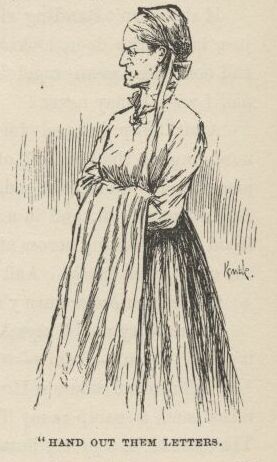
Aunt SallyAlthough the United States was born in the Enlightenment, it was bred in Romanticism. The conflict in American culture between the two traditions is wonderfully memorialized in Huckleberry Finn in the standoff between Aunt Sally, who belongs to the school of Plato and St. Augustine, and Huck Finn, who is a Wordsworthian:

. . . if I'd'a' knowed what a trouble it was to make a book, I wouldn't'a' tackled it, and ain't a-going to no more. But I reckon I got to light out for the Territory ahead of the rest, because Aunt Sally she's going to adopt me and sivilize me, and I can't stand it. I been there before.

   Huck is confident that he will maintain his happiness and virtue better out in the Territoy, close to nature,than he will in town, near civilization and Aunt Sally. But there is little in human history to justify this Romantic faith.

    The conflict between our Enlightenment and our Romantic views of human nature continues unabated in American culture today. Lately, there has perhaps occurred a tempering of our optimism about the beneficence of things natural and the innate goodness of human nature -- the tragedy of the Vietnam War, the halt in continually rising prosperity, the omnipresent television scenes of genocidal conflict throughout the world, the violence among children in our schools -- this drumbeat of tragic experience has tended to qualify our anti-tragic Romantic faith in the inherent goodness and dependability of the human child when allowed to follow its own development. Increasingly, there has been a questioning of the belief that all will be well if the child is encouraged to grow naturally like a tree, and there has been a renewed interest in the idea of moral education -- a kind of symbolic reinstatement of Aunt Sally.

-- From The Schools We Need by E.D. Hirsch, pp. 77-78.

Continue reading
0

The Catechetical Service

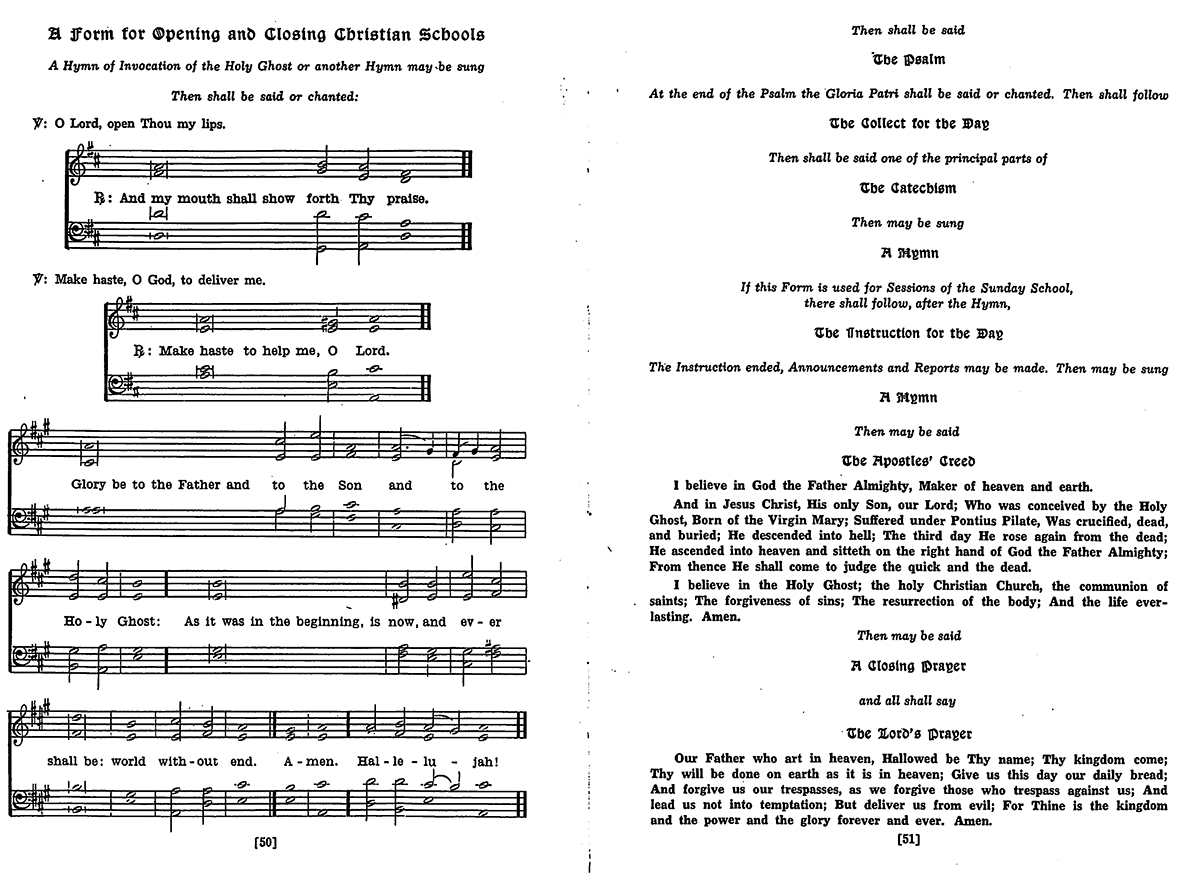
Catechetical ServiceSince the publication of The Lutheran Hymnal (TLH), no hymnal produced by The LCMS has contained "A Form for the Opening and Closing of Christian Schools." We, however, follow this delightful little order (found on pages 50-52) as a signifcant part of our worship life each week.

Besides containing two of the Six Chief Parts (The Apostles' Creed and The Lord's Prayer), the order explicitly has a place for "The Catechism" at which point the pastor turns to the gathered student body and faculty asking, "What is the Second Commandment? and "What does this mean?" hearing in reply what the students have been practicing in their Weekly Catechesis recitations.

Following that recitation, all join in singing the corresponding hymn or stanza from Luther's catechetical hymns -- but we don't always sing the entire hymn. So, for example, in the week for The Second Commandment, we sing stanzas 1, 3, and 12 of TLH 287, That Man A Godly Life Might Live, or again, in the week when The Fourth Petition is assigned, we sing only stanza 5 of TLH 458 Our Father, Who in Heav'n Above.

Then comes the sermonic instruction based on an appointed Bible memory verse which is included in our Weekly Catechesis booklet.

After the sermon, treated as a "proper" of the service, we sing TLH 288, Lord, Help Us Ever to Retain the Catechism's Doctrine Plain. In just three stanzas, this delightful little hymn includes a simple poetic reference to each of the Six Chief Parts.

One further interesting detail: for the psalmody, the portions of Psalm 119 are assigned. This psalm has much to say about godly instruction and the number of its sections match up with the number of the portions of the first three chief parts. It is only at the point of "What is meant by 'Amen'?" that we have to draw upon other psalms to finish the second half of the year. These psalms are selected from the recommendations in TLH, pages 166-168 based on the church year.

Continue reading
0

Motivate . . . or Enliven?

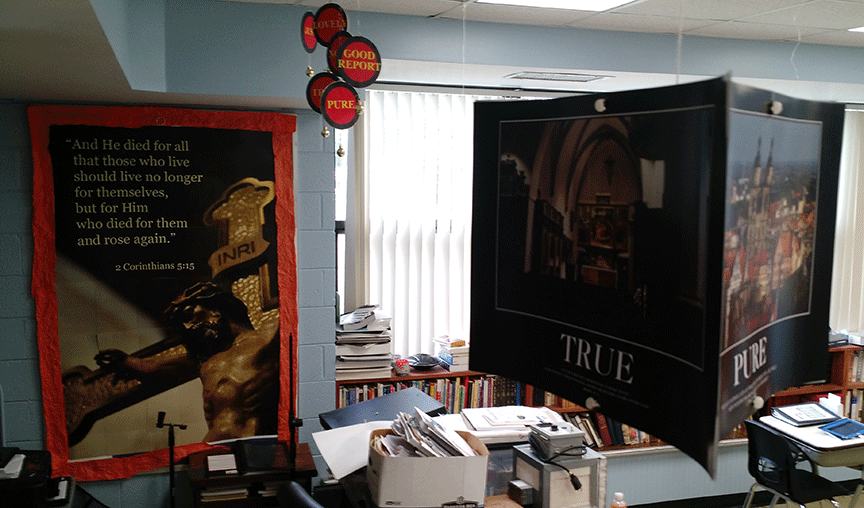
Some teachers like to put up motivational posters to dress up their classroom and inspire their students. While good quotes from various authors can be thought-provoking, their words don't bear the promise of the Holy Spirit. We like to enliven our students with God's living Word by which He upholds all things (Hebrews 1:3).

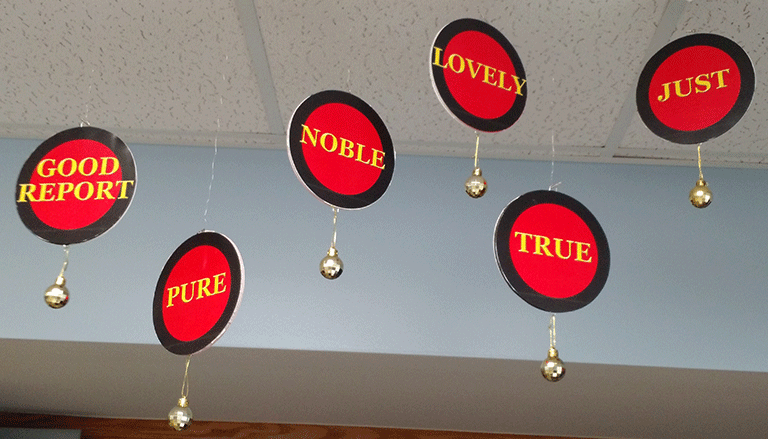
Phil 4 8Philippians 4:8 is a passage which we take to heart in classical Lutheran education: "Finally, brethren, whatever things are true, whatever things are noble, whatever things are just, whatever things are pure, whatever things are lovely, whatever things are of good report, if there is any virtue and if there is anything praiseworthy--meditate on these things. " These are the adjectives we prefer to use regarding schoolwork instead of cool, fun, exciting, and awesome.  Using foam board, a circle cutter, some paperclips, mini Christmas ornaments and ceiling clips from FFR, Inc, (ffr.com, Cleveland, OH), I made these medallions for my classroom to serve as touchstones throughout the year. When going over student work, I might ask them, "Which of those adjectives best describes your work?"


PosterThen, I also found a website which would let me design my own "motivational" posters. I used the adjectives from Philippians 4 and associated other Bible passages with them (see below). I added pictures from Luther's Wittenberg with the anniversary of the Reformation in mind. (This triangular ceiling clip is also from FFI.) Lastly, as you might be able to see on the bulletin board in the background, I used a program to enlarge a photo I took in our sanctuary. This program simply enlarges the photo automatically so that it can be printed on 8.5 x 11 sheets of paper and then stitched together.
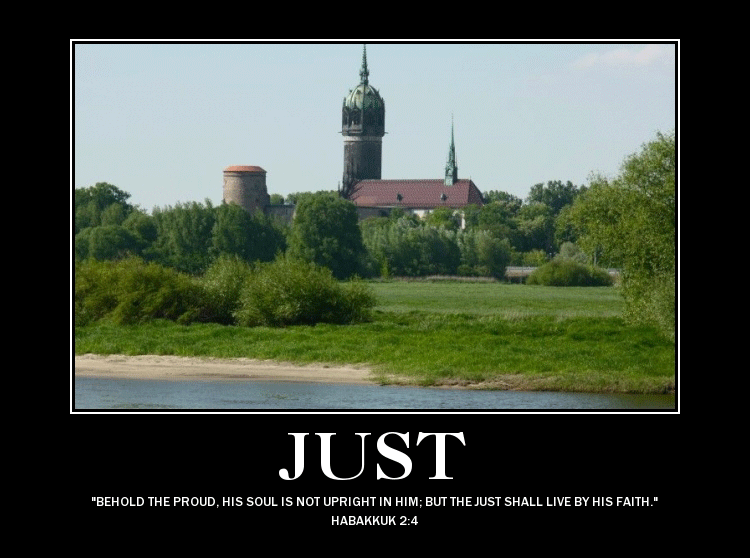


Just

Continue reading
0

Amusing Children?

In her 1953 survey and critique of Canadian progressive education entitled So Little for the Mind, Hilda Neatby wrote (in a style that might seem tongue-in-cheek):

"The crowning virtue of the modern school, the secret of all its success is that the children do what they want to do, or they want to do what they are doing. 'They have such a good time.' In music, they learn no theory: it is such hard work. They play on a tonette by numbers.

"In art, the object of the programme from Grade I to VIII is 'to give the child confidence in his own ability and to instill a sense of achievement and satisfaction in what he is doing,' an art supervisor is reported as saying.And, in answer to the natural inquiry about the child with little or no ability, 'I have never seen a child's picture yet that hasn't something good in it.' As the child alone knows what he means, 'he is right in the way he draws it' and he gets a sense of continued achievement, a feeling of 'I am really good.'

"But should it be a 'major aim' of the school either to amuse the children or to make them feel that they are 'really good'? Would it not be better to avoid complacency as well as frustration by providiing healthy and vigorous occupations for the mind?" (pp 203-204).

Continue reading
0

The Grammar of Our Civility

PearcyThe Grammar of Our Civility: Classical Education in America by Lee T. Pearcy

"Why do we have to learn this stuff?" Pearcy offers a much-needed apologetic for classical education. Teachers and administrators of classical  schools may find this book especially helpful in defending a liberal arts education whether it be to plaintive students, critical parents, or a skeptical  public.

While noting that the case against a liberal arts education has been heard for over a century (e.g. Charles Darwin, "Nothing could have been worse for the development of my mind."), Pearcy also comes to grips with those who present a utilitarian argument and those who merely want to perpetuate tradition.

"The natives of university departments of Classics have failed to notice the disappearance of the language whose grammar was their practice. The culture of the governing class that classical education once served has disappeared. The fact of a governing class, of course, has not, but the executives, bureacrats, managers, and legislators of modern America share no single, coherent, humane culture," (p. 5).

Pearcy lays the blame not entirely on culture, but upon those who teach the Classics: "The professors have also forgotten why Classics was once important. In ignorance of their new circumstances, they have created a false grammar . . . In creating their false grammar, the professors have had to create false paradigms," which leads him to the work presented in this book: "Now let us rehearse the true paradigms. Then let us examine those quaint people, the professors of Classics, and the false paradigms they have created to make sense of their new world and their new masters." (pp. 5-7)

The true paradigms for Pearcy are a liberal arts education an Altertumwissenschaft which together formed the grammar of classical education: "One way of thinking emphasizes things, the objective, scholarly study of what survives from classical antiquity. For that mode of thinking about classical education I shall use a German term Altertumwissenschaft. . . . The second way of thinking about classical education emphasizes not things but processes. It is concerned less with the remains of antiquity in themselves than with their effect on those in the present who are exposed to them. This second way of thinking about classical education had, from its origins, a familiar name: liberal arts education." (pp. 6-7)

From a secular perspective, Pearcy's contribution will be valued by those desiring a stong footing and clear perspective when commending classical education to others. To this, confessional Lutherans will bring the ultimate motive and energy for serving one's neighbor in love in the Gospel which the Lord graciously gives as we look to Him in faith.

Continue reading

EasyBlog - Posts List

Go to top